History

Beer as medicine

Back in the Middle Ages, abbeys ran breweries primarily for sanitary reasons. While it might not sound very romantic, beer helped prevent typhoid and other deadly epidemics from being spread through contaminated water. And since people in the Middle Ages had no way to test whether spring water was safe, the sterilisation process used to brew beer was the best way to prevent contamination with the notorious Salmonella Typhi bacterium.

First historical reference

The Leffe Brewery is located on the right bank of the Meuse River, about 1 kilometre south of the town of Dinant. In 1152, the Premonstratensian Fathers founded the Notre-Dame Abbey where the Leffe and Meuse rivers meet. The abbey’s name was changed to Leffe Abbey in 1200. The monks brewed ale made of natural ingredients and based on a recipe that had been passed down from generation to generation. The first reference to the brewery in historical records dates back to 1240.

The flood

The 15th century was disastrous for the Leffe Abbey. Historians say that the Abbot and seven of the monks died of the plague in 1400. Then, on 7 August 1460, the Leffe church was struck so hard by a flood that only its four walls remained standing. The Abbot at that time drowned in the disaster, and the other monks managed to escape to the monastery tower just in the nick of time. And no sooner had the flood damage been repaired than Dinant was besieged by Charles the Bold and his forces, who looted and vandalised the Abbey.

The fire

On 23 August 1466, the city of Dinant was forced to surrender to Charles the Bold. As Burgundy was one of the largest regions of France at that time, Charles the Bold, Duke of Burgundy, was a very powerful figure and a major rival to Louis XI and the French throne. The people of Dinant had the foolish audacity to spread the rumour that Charles had actually been defeated and that he was the bastard son of Duchess Isabel and the Bishop of Liège. Incensed by the rumour, Charles the Bold invaded Dinant to defend his mother’s honour. His forces killed every man, woman and child in the city, and the Abbey was ransacked, set on fire, and almost entirely destroyed.

The rampage

In 1735, the Leffe Abbey was forced to house a regiment of Hussars – Hungarian mercenaries who were notorious for their brutality. They roamed through the countryside looting and pillaging, and they were particularly feared for their cruel treatment of local civilians. The Hussars showed no respect for the Abbey’s religious nature, and they plundered the building and everything in it. The brewery, too, suffered terribly from their rampage: the barrels of beer that the mercenaries had not guzzled during their attack were broken or smashed open.

The abbey is sold

The brewery was being rehabilitated when a new danger appeared: French Republican troops, who arrived with the outbreak of the French Revolution in 1794. For centuries under the old regime, the church had been the country’s largest landowner. The new regime refused to recognise the church’s special status and all of its property was confiscated. In 1796, the Abbey was officially abolished and declared to be the property of the state. A glorious, turbulent era of 640 years of hard work, sacrifice and courage came to an end. In the years that followed, the Abbey changed hands repeatedly and, little by little, was sold off. The brewing activities continued on a smaller scale until 1809, when they were discontinued altogether.

Historical building

On 1 February 1937, the Leffe Abbey was classified as an historical building.

Brewing weaponry

Historians report that, during the First and Second World Wars, the occupying forces melted down most of the Abbey’s brewing kettles to make weapons and ammunition.

Leffe Brown is brewed again

Life in the monastic community was harsh. The young brethren made incense and ink that they sold to fellow priests throughout Belgium – just managing to bring in enough money to keep the community alive. The Abbey had not brewed beer since the French Revolution – when Father Abbot Nys met Albert Lootvoet, a brewer at Overijse, in 1952. The two men decided to revive Leffe Abbey’s illustrious brewing tradition by again brewing beer based on the traditional recipe and processes. The Abbey began to brew Leffe Dark beer in 1952 – and it was an instant success.

Leffe abbey today

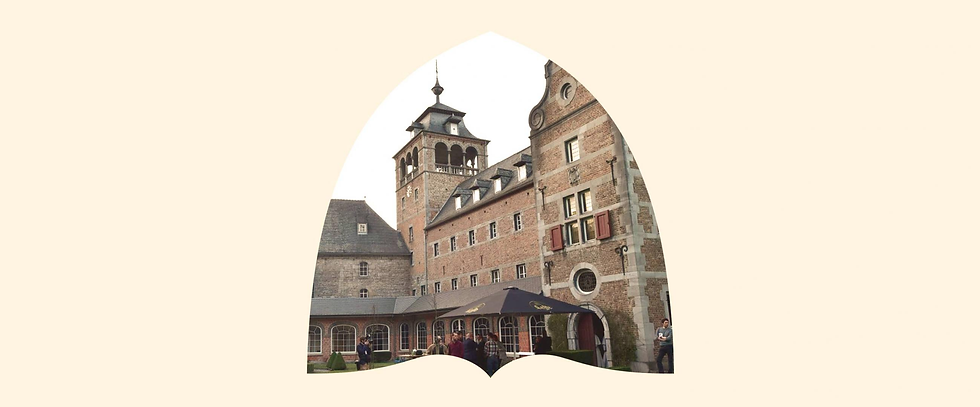
The quadrilateral Abbey is constructed of brick, dressed stone and calcareous quarry stone with a slate roof. The Abbey Church was consecrated in 1460 to replace the one that was destroyed by the 1460 flood, but only the narthex remains today. A barn built in 1710 was converted into the Abbey Church in the early 20th century. The main entrance leads into a courtyard surrounded by buildings. The guest house is now located in the eastern aisle, called the "Prélature". The southern aisle is a series of attached buildings dating from the 17th and 18th centuries. A former warehouse, now fully refurbished, serves as the monks’ living quarters.